What happens to skin in a fire
Self-contained breathing apparatus protects against inhalation. The skin is the second major route by which combustion products enter the body, and breathing apparatus doesn't help against it.
Four steps from the fire to the skin
Warm, sweaty skin is more permeable. Sweat and moisture soften the stratum corneum.
Greasy soot carrying PAHs sticks to the skin's sebum, especially where the gear doesn't seal.
They are absorbed from the stratum corneum even after the fire, until we wash them off.
Irritated, dry skin and eczema. Damaged skin lets in even more.
Step 4 describes field experience and general principles of dermatology. The higher incidence of some cancers in firefighters is described below.
What is on the skin after a fire
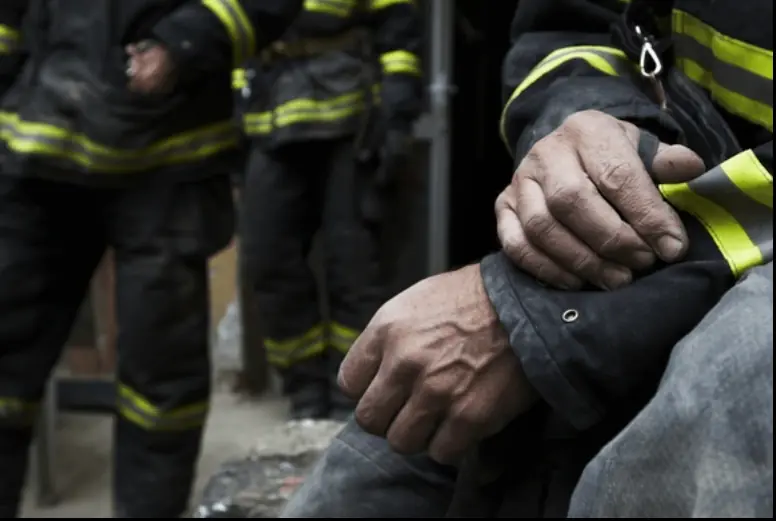
Incomplete combustion produces a mixture of gases, aerosols and soot. In terms of cancer, the most important are polycyclic aromatic hydrocarbons (PAHs), including benzo[a]pyrene, a proven carcinogen. PAHs are lipophilic: they bind to soot and cling to the greasy film on the skin. That is why water alone doesn't wash them off.
Where turnout gear doesn't seal
Contamination gets in at the interfaces: between the hood and the collar, between the sleeve and the glove, and around the face mask. Skin swabs after fires therefore repeatedly find the most PAHs on the:
- neck and jaw
- face, especially around the mask
- wrists and hands
PAHs are also found under the gear, for example on the back, in the groin and the backs of the knees, where the gear rubs and sweat collects.
Banks et al., 2021 · chipboard fire, selected PAHs (phenanthrene, pyrene etc.)
Skin is probably the main route of uptake
In a Swedish study, the level of 1-hydroxypyrene in urine (a PAH metabolite) correlated best with the amount of PAHs on neck skin (Wingfors et al., 2018). Fent et al. (2014) and Keir et al. (2017) concluded that when breathing apparatus is worn, PAHs enter the body mainly through the skin.
Heat
Warm skin is more permeable.
Sweat and moisture
A hydrated stratum corneum lets substances through more easily.
Add to that skin damaged by gear friction or chemically. During a fire, all of this acts at once.
Time matters. Absorption from the skin surface doesn't stop when exposure ends. The stratum corneum acts as a reservoir from which substances keep penetrating. The longer soot stays on the skin, the more of it is absorbed.
The reservoir principle is well known in dermal toxicology. We have not found its extent measured for the specific PAH mixture from fires.
First responders into the shower first. The first attack crew is exposed to the heaviest contamination. If the forces and resources at the scene allow it, get them to a shower as soon as possible.
Cancer in firefighters

In June 2022, the International Agency for Research on Cancer (IARC) classified occupational exposure as a firefighter in Group 1, i.e. among agents carcinogenic to humans. It found sufficient evidence for mesothelioma and bladder cancer, and limited evidence for, among others, colon, prostate and testicular cancer, melanoma and non-Hodgkin lymphoma (Demers et al., 2022).
Meta-analysis of 48 studies, Jalilian et al., 2019
A cohort of almost 30,000 career firefighters from San Francisco, Chicago and Philadelphia (1950–2009) had 9 % higher cancer incidence and 14 % higher cancer mortality than the general population, and roughly twice the incidence of mesothelioma (Daniels et al., 2014).
How to read the data. These numbers describe the risk of the occupation as a whole and don't distinguish individual exposure routes. Nobody has yet quantified how much of the risk is due to the skin specifically. Measurements of skin contamination and urinary PAH metabolites do, however, support that it is a significant route.
And in the Czech Republic?
Comparable data for Czech firefighters are lacking. Finding out whether they develop cancer more often than the general population would require linking personnel records of the Czech Fire Rescue Service with the National Cancer Registry. The GDPR doesn't prohibit such research, but health data may be processed for scientific purposes only on a legal basis and with safeguards, such as pseudonymisation or firefighters' informed consent (Art. 9(2)(j) and Art. 89 GDPR). As far as we know, no such project has been carried out yet.
European Union: a PAH limit and a warning about the skin
Directive (EU) 2026/2450 of the European Parliament and of the Council of 21 October 2026 amends Directive 2004/37/EC on the protection of workers from carcinogens, mutagens and reprotoxic substances. For the first time it sets a binding occupational exposure limit in workplace air for mixtures of polycyclic aromatic hydrocarbons: 0.00007 mg/m³, measured as benzo[a]pyrene. A less strict limit of 0.00014 mg/m³ applies until 20 November 2033 only to selected industries, such as steelworks, coke ovens and foundries.
PAHs also keep the “Skin” notation. ECHA's Committee for Risk Assessment identified the possibility of significant uptake of these mixtures through the skin. An air limit alone therefore does not protect firefighters; skin decontamination matters too.
The directive explicitly names firefighters and other emergency services personnel as workers exposed to carcinogens during fires and other incidents. Their employers must assess and reduce the risk of exposure, including to PAHs. The directive also notes that firefighters are often exposed to a combination of substances, and introduces two new obligations for all workers:
- Personal protective equipment, especially respiratory protection, is a last resort where exposure cannot be prevented by other means. It must be properly selected, fitted to the wearer and maintained.
- Workers using personal protective equipment are entitled to regular breaks in an environment free from the risk of contamination by carcinogens.
The directive was published in the Official Journal on 30 October 2026 and Member States must transpose it into national law by 20 November 2028.
Source: Directive (EU) 2026/2450, OJ L, 30.10.2026, recitals 14, 15, 23 and 24, Articles 1 and 2, Annex