What an officer can introduce
Most measures are organisational, require no investment and fall within the authority of the unit or crew officer.
Five measures
A dedicated space for dirty PPE
On the vehicle and at the station. None of it belongs in the cab or at home.
Rule on the vehicle
After the job, wash neck, face, wrists and hands with cleanser and water, shower as soon as possible.
Standard: shower within an hour
After every incident with combustion products. If the forces and resources at the scene allow it, get the first responders to a shower as soon as possible: the first attack crew is exposed to the heaviest contamination.
Supplies at hand
Cleanser and rinse water in the vehicle, wipes only as a backup, cream at the station.
Professional PPE cleaning
And protective equipment for whoever washes the gear.
Lead by example
When the officer follows decon and treats it as part of the job, the crew will adopt it.
Station checklist
- Every vehicle carries bags or sacks for contaminated PPE.
- Every vehicle carries cleanser and rinse water, wet wipes only as a backup.
- The station has a marked dirty and clean zone.
- The showers have a gentle product for greasy soiling and soft washcloths.
- There is repair cream by the showers.
- The technician who washes the gear has gloves, an apron, eye protection and a half mask.
- Spare PPE is available so nobody has to put on dirty gear.
How others do it
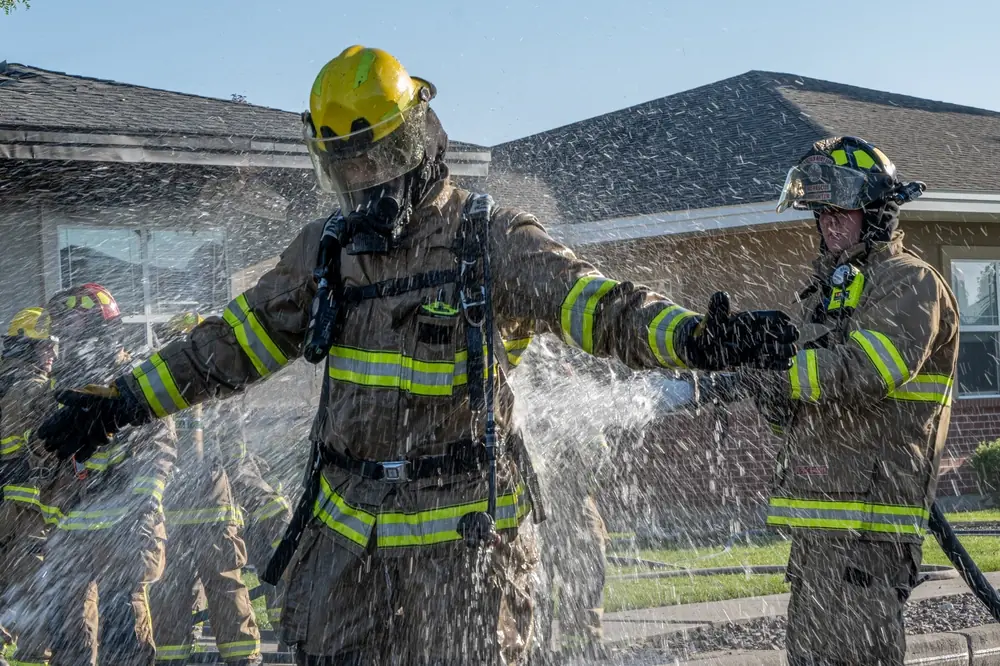
In the United States, wet gross decontamination right on scene ("on-scene gross decon") is common practice.
- On-Scene Gross Decontamination (Miami-Dade Fire Rescue)
Rinsing PPE with soapy water right after exiting and wiping the skin. See also the Fire Engineering article. - Post-Fire Cold Weather Wet Decon (Firefighter Nation)
Wet decon at −8 °C. An answer to the objection that it can't be done in winter. - Photos from DVIDS
Mountain Home Air Force Base (Idaho) firefighters during decon at a house fire. Photo: U.S. Air Force / SSgt Anne Ortiz.
What would help next
There is no standard procedure for verifying that a firefighter is really clean after a fire. International studies use swabs of neck, wrist and hand skin after the job and again after decon, with laboratory PAH analysis. Such a procedure would make it possible to compare cleansers and tools in real conditions and to base internal standards on your own data.
It should also include an assessment of skin tolerance with repeated use: transepidermal water loss (TEWL), hydration, redness and firefighters' complaints over several weeks of service. Field studies have not yet assessed skin irritation after decon.